
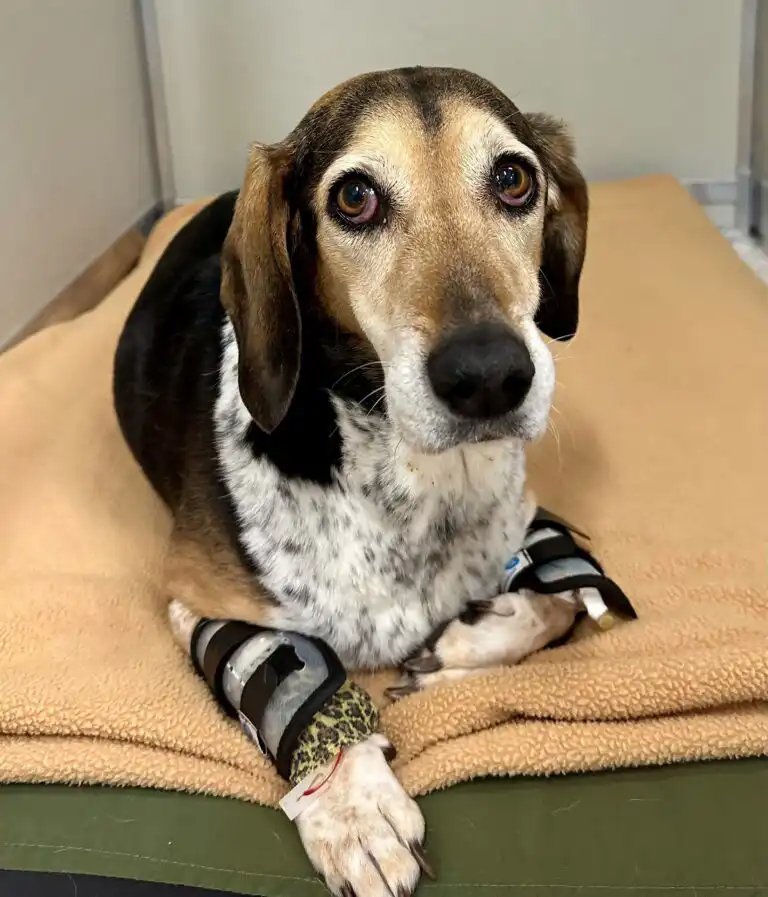
If your dog is suddenly reluctant to jump, walking stiffly, or showing signs of pain, IVDD may be the cause.
Intervertebral disc disease (IVDD) is a common spinal condition that can range from mild discomfort to paralysis. IVDD occurs when the discs between the bones of the spine degenerate or rupture, putting pressure on the spinal cord. Early recognition is critical for the best outcome.
What Is IVDD?
Intervertebral Disc Disease (IVDD) is a common spinal condition that affects many dogs. IVDD is a degenerative process where the center of the disc (nucleus pulposus) degenerates, and makes the disc more vulnerable to herniation/extrusion (IVDE). Certain breeds (chondrodystrophic breeds), such as Dachshunds, Corgis, and French Bulldogs, are especially prone to IVDD. At Wisconsin Veterinary Neurology we are very comfortable treating all kinds of disc disease and our very own Dr. Moeser recently wrote a paper describing the various types of disc extrusion/protrusions which fall under the category of IVDD.
Symptoms of IVDE (extrusion/herniation)
Common symptoms of a disc extrusion can include, but are not limited to:
- Low head carriage
- Arched back (kyphosis)
- Pain when touched or picked up
- Loss of coordination (ataxia) of limbs
- Loss of voluntary movement of limbs (paralysis)
- Loss of fecal/urinary continence
Early detection is key, so if your dog shows any of these symptoms, please contact us or your veterinarian immediately.
Diagnosing IVDE
The first step in diagnosis IVDE is a good neuro examination. If your dog has neurologic abnormalities suggesting a spinal cord condition (myelopathy), further testing may be recommended. The best test we have for diagnosis of intervertebral disc extrusions is an MRI. Other possible diagnostic modalities include myelography or CT +/- myelography.
Treating IVDE
- Conservative Management: Crate rest, pain medication, and anti-inflammatory drugs. Conservative care is best reserved for dogs that are still able to walk, but may be tried in all cases. Overall the prognosis is guarded.
- Surgery: Surgery offers the best prognosis for a good outcome, and is often utilized regardless of severity. However, in severe cases where the patient can’t walk, surgery is strongly recommended. Prognosis depends on the presence of nociception (sensation), and ranges form good/excellent to guarded.
Conclusion
IVDE is a common condition in small animal veterinary medicine. If your pet is showing signs of spinal cord disease, early evaluation is important.
During your visit, we’ll carefully assess your pet, explain what we’re seeing, and guide you through the best options for diagnosis and care.
Please don’t hesitate to give us a call, we’re here to help.
FAQs About IVDD in Dogs
- What breeds are most prone to IVDD?
Chondrodystrophic breeds (i.d. Dachshunds, Beagles, French Bulldogs, etc.) are most commonly affected, but any breed can be affected. - Can IVDE affect cats?
While less common, cats can develop IVDE. Symptoms and treatment options are similar to those in dogs. - Is surgery always necessary for IVDD?
Not always. Mild cases can often be managed through rest, and medication. However, in severe cases (patient can’t walk), surgery is typically recommended if possible.